

Upcoming seminar
Reimagining Doctoral Futures Together: Collective Agency, Creative Art of Living and New Possibilities
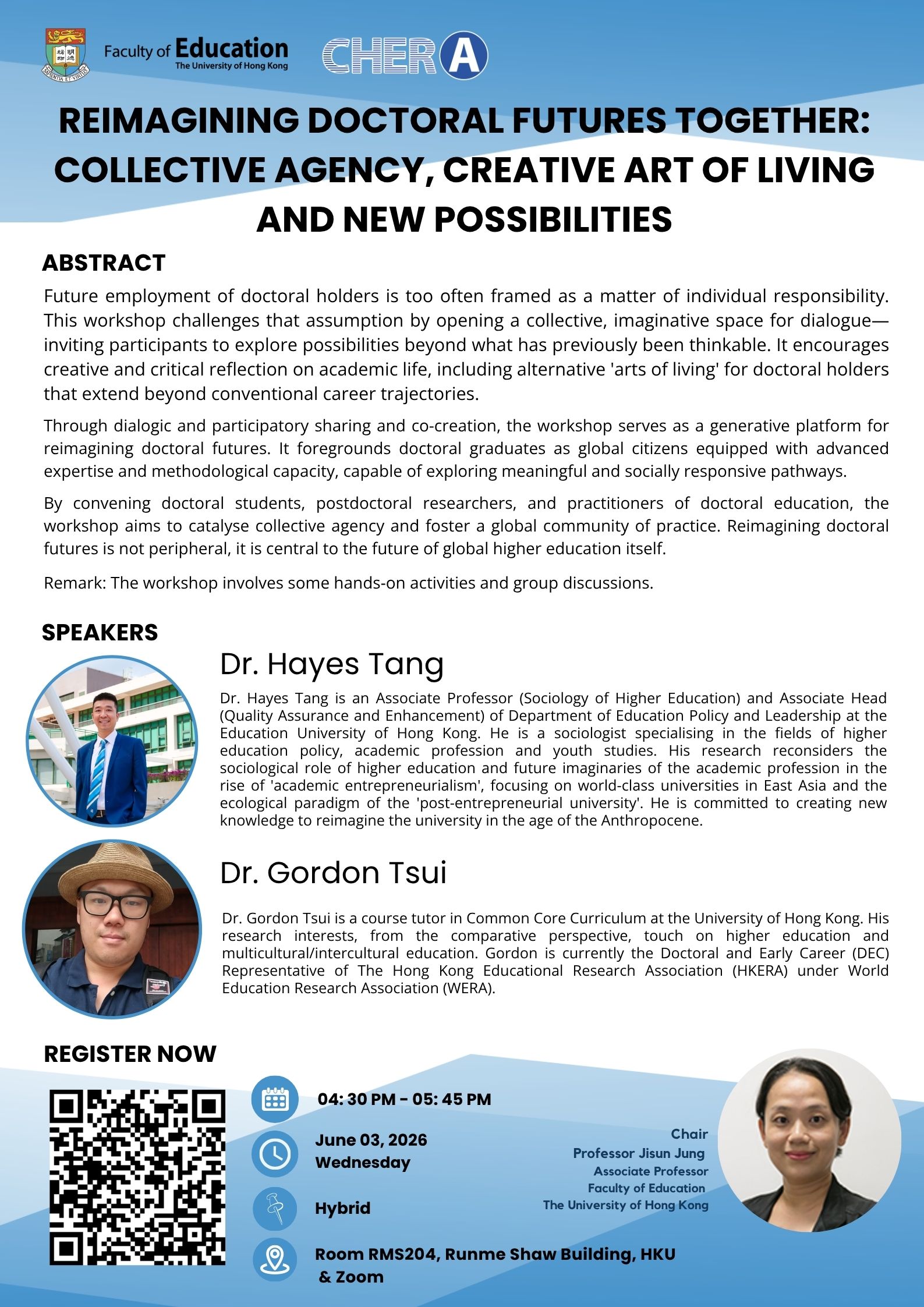
Upcoming Workshop: Reimagining Doctoral Futures Together: Collective Agency, Creative Art of Living and New Possibilities
Date: 03 June, 2026 (Wed)
Time: 04:30 PM– 05:45 PM HK
Type: Hybrid
Venue: RMS204, Runme Shaw Building, HKU & Zoom
Registration: Scan the QR code or use the link
Speakers:
Dr Hayes Tang, Associate Professor and Associate Head of Department of Education Policy and Leadership at the Education University of Hong Kong
Dr Gordon Tsui, Course Tutor in Common Core Curriculum at the University of Hong Kong
Abstract:
Future employment of doctoral holders is too often framed as a matter of individual responsibility. This workshop challenges that assumption by opening a collective, imaginative space for dialogue—inviting participants to explore possibilities beyond what has previously been thinkable. It encourages creative and critical reflection on academic life, including alternative ‘arts of living’ for doctoral holders that extend beyond conventional career trajectories.
Through dialogic and participatory sharing and co-creation, the workshop serves as a generative platform for reimagining doctoral futures. It foregrounds doctoral graduates as global citizens equipped with advanced expertise and methodological capacity, capable of exploring meaningful and socially responsive pathways.
By convening doctoral students, postdoctoral researchers, and practitioners of doctoral education, the workshop aims to catalyse collective agency and foster a global community of practice. Reimagining doctoral futures is not peripheral, it is central to the future of global higher education itself.
About the Speakers:
Dr. Hayes Tang is an Associate Professor (Sociology of Higher Education) and Associate Head (Quality Assurance and Enhancement) of Department of Education Policy and Leadership at the Education University of Hong Kong. He is a sociologist specialising in the fields of higher education policy, academic profession and youth studies. His research reconsiders the sociological role of higher education and future imaginaries of the academic profession in the rise of ‘academic entrepreneurialism’, focusing on world-class universities in East Asia and the ecological paradigm of the ‘post-entrepreneurial university’. He is committed to creating new knowledge to reimagine the university in the age of the Anthropocene.
Dr. Gordon Tsui is a course tutor in Common Core Curriculum at the University of Hong Kong. His research interests, from the comparative perspective, touch on higher education and multicultural/intercultural education. Gordon is currently the Doctoral and Early Career (DEC) Representative of The Hong Kong Educational Research Association (HKERA) under World Education Research Association (WERA).
Remark: The workshop involves some hands‑on activities and group discussions.
Research Integrity and Political Neutrality
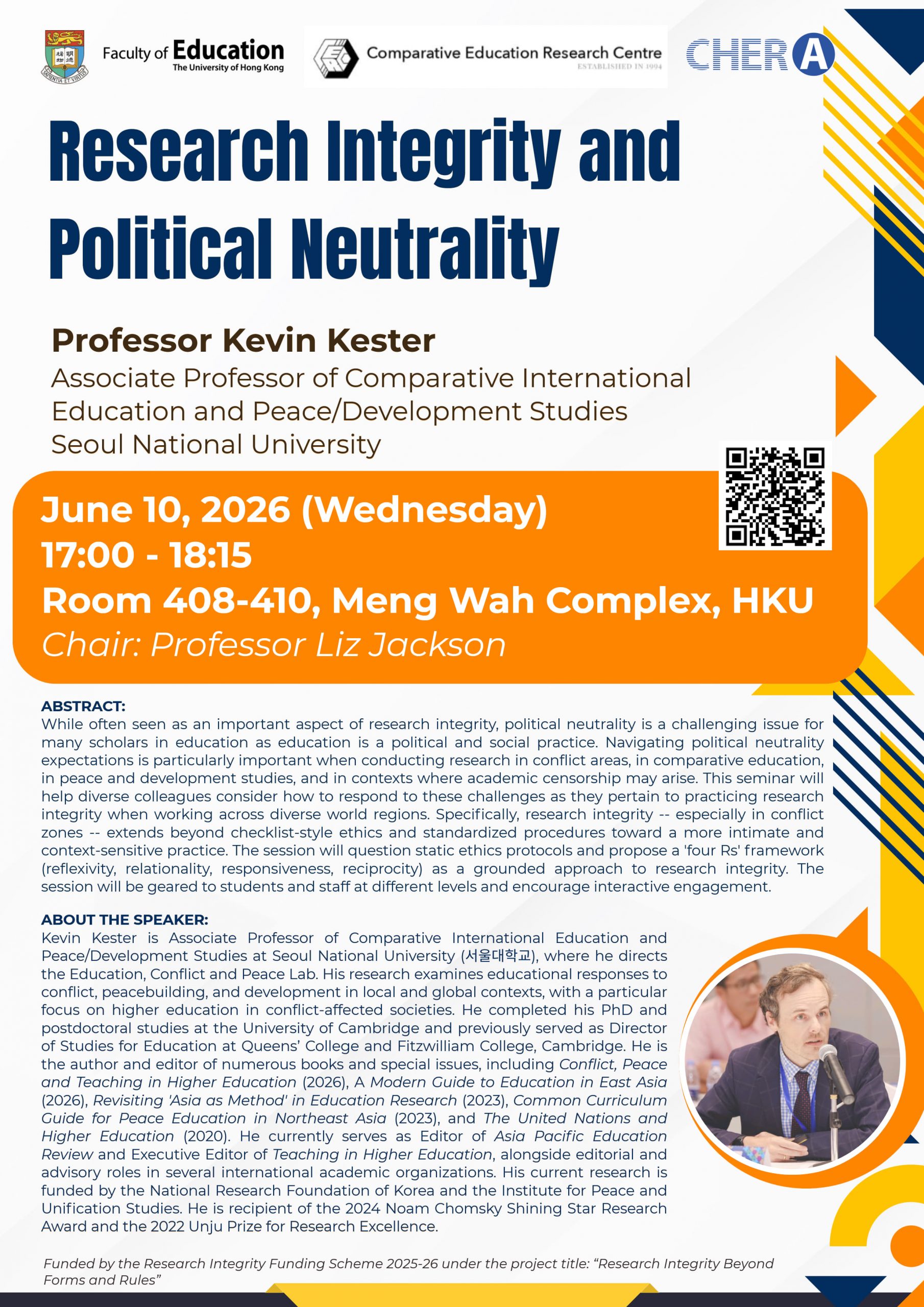
Upcoming Seminar: Research Integrity and Political Neutrality
Date: 10 June, 2026 (Wed)
Time: 17:00 – 18:15
Type: In-person
Venue: Room 408-410, Meng Wah Complex, HKU
Registration: Scan the QR code
Speaker: Professor Kevin Kester (Associate Professor of Comparative International Education and Peace/Development Studies, Seoul National University)
Chair: Professor Liz Jackson (The University of Hong Kong)
Abstract:
While often seen as an important aspect of research integrity, political neutrality is a challenging issue for many scholars in education, as education is a political and social practice. Navigating political neutrality expectations is particularly important when conducting research in conflict areas, in comparative education, in peace and development studies, and in contexts where academic censorship may arise. This seminar will help diverse colleagues consider how to respond to these challenges as they pertain to practicing research integrity when working across diverse world regions. Specifically, research integrity—especially in conflict zones—extends beyond checklist-style ethics and standardized procedures toward a more intimate and context-sensitive practice. The session will question static ethics protocols and propose a ‘four Rs’ framework (reflexivity, relationality, responsiveness, and reciprocity) as a grounded approach to research integrity. The session will be geared to students and staff at different levels and encourage interactive engagement.
About the Speaker:
Kevin Kester is Associate Professor of Comparative International Education and Peace/Development Studies at Seoul National University (서울대학교), where he directs the Education, Conflict and Peace Lab. His research examines educational responses to conflict, peacebuilding, and development in local and global contexts, with a particular focus on higher education in conflict-affected societies. He completed his PhD and postdoctoral studies at the University of Cambridge and previously served as Director of Studies for Education at Queens’ College and Fitzwilliam College, Cambridge. He is the author and editor of numerous books and special issues, including Conflict, Peace and Teaching in Higher Education (2026), A Modern Guide to Education in East Asia (2026), Revisiting ‘Asia as Method’ in Education Research (2023), Common Curriculum Guide for Peace Education in Northeast Asia (2023), and The United Nations and Higher Education (2020). He currently serves as Editor of Asia Pacific Education Review and Executive Editor of Teaching in Higher Education, alongside editorial and advisory roles in several international academic organizations. His current research is funded by the National Research Foundation of Korea and the Institute for Peace and Unification Studies. He is recipient of the 2024 Noam Chomsky Shining Star Research Award and the 2022 Unju Prize for Research Excellence.
Remark: Funded by the Research Integrity Funding Scheme 2025-26 under the project title: “Research Integrity Beyond Forms and Rules”
Higher Education in China
Domestic Demands and Global Aspirations
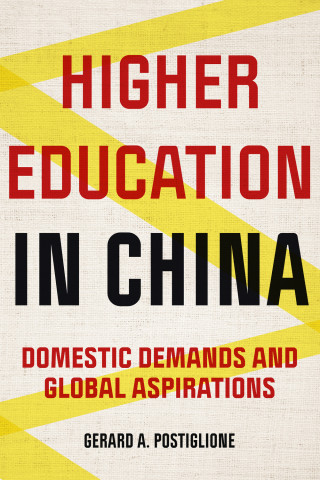
Assessing the trajectory of China’s higher education system amid competing domestic priorities and global ambitions.
By 2025, China had twice as many college students as the United States, four times as many STEM graduates, and double the number of STEM PhDs. What will it mean for the global future when a quarter of a billion Chinese citizens hold higher education degrees? In this timely book, Gerard A. Postiglione—an internationally recognized authority on Chinese education—offers a panoramic view of the world’s largest state-directed higher education system and its complex interplay with China’s social, economic, and geopolitical ambitions.
At the center of Postiglione’s analysis is the tension between domestic imperatives and global aspirations. As China aims to cultivate a world-significant higher education system by 2035, it faces a trio of formidable challenges: graduate employment, equitable access, and governance reform. Higher Education in China unpacks how elite Chinese research institutions and rapidly expanding second- and third-tier colleges are navigating these pressures amid a shifting landscape shaped by urban-rural inequality, labor market demands, and technological disruption.
Based on policy consultation with China’s Ministry of Education and on-the-ground research in nearly every province, Postiglione’s account brings unmatched depth and perspective. He traces how returnee scholars, massification policies, and regional development initiatives have transformed campuses and classrooms, while also posing difficult questions about sustainability, quality, and inclusion. Higher Education in China illustrates how the country’s evolving academic system may influence its long-term trajectory—and, by extension, reshape the global order of knowledge and innovation.
香港大學世紀之問 —— 改革開放初期與內地交流的人和事
HKU in the Early Days of Reform and Opening-up
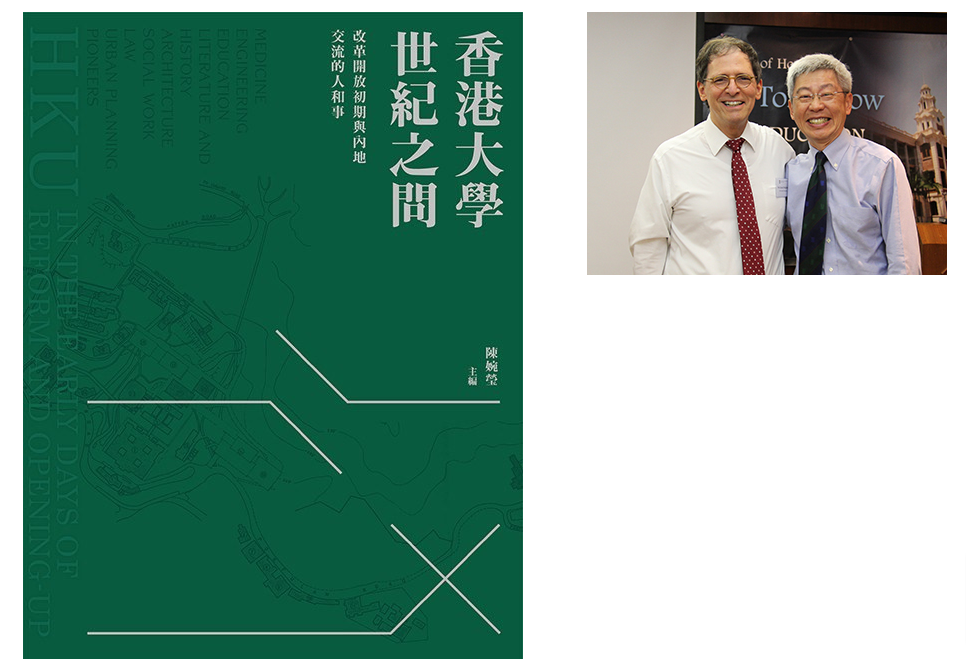
| 《香港大學世紀之問 —— 改革開放初期與內地交流的人和事》 HKU in the Early Days of Reform and Opening-up |
| 主編:陳婉瑩 Editor-in-chief: Ying Chan 出版:三聯書店(香港)有限公司 Publisher: Joint Publishing (H.K.) Co., Ltd. |
| This book tells the story of 18 individuals who pioneered academic and professional exchanges between HKU and mainland China in the 1980’s. These men and women blazed the trail in eight sectors, medicine, engineering, literature and history, education, architecture, social work, law, and city planning, with expertise and dedication. Our CHERA members, Professors Gerard A. Postiglione and Cheng Kai Ming, actively engaged in exchange and communication with the mainland during the Reform and Opening-up period. They are prominently featured in the book with documents, stories, analysis, and photos. |
Jamil Salmi (ed.) (2023). Transforming Lives at the Institutional Level: Equity Promotion Initiatives Across the World
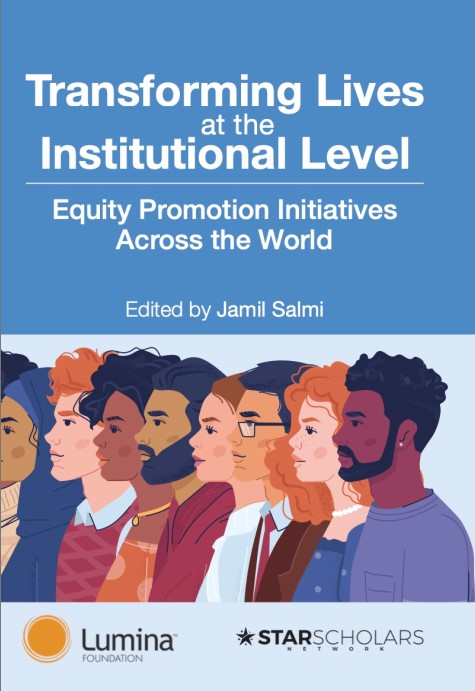
In the ever-evolving landscape of global education, the quest for equitable access to quality higher education remains a pressing challenge. Across the world, countless children and young individuals confront daunting circumstances that impede their educational opportunities due to factors such as race, gender, socioeconomic background, and geographical origin. This particularly affects those in developing countries and marginalized groups globally. To address this issue, promoting inclusivity and pluralism within higher education institutions has become an imperative driven by the principles of social justice and the United Nations’ Sustainable Development Goals.
Throughout Transforming Lives at the Institutional Level: Equity Promotion Initiatives Across the World, readers will gain profound insights into various equity-focused initiatives. From integrating low-income students into university cultures and implementing student aid programs to promoting balanced regional selection and supporting students with disabilities, the case studies offer a wealth of knowledge and good practices. They delve into affirmative action, indigenous inclusion, coaching programs, and many more initiatives aimed at improving access for underrepresented groups. This volume underscores the importance of comprehensive equity promotion policies that encompass financial and nonmonetary aspects. It emphasizes the need for coordination between national and institutional actions, with an equal focus on both access and completion. Long-term perspectives and well-established information systems are essential in effectively addressing equity gaps and measuring progress.
Editor
Jamil Salmi, Global Tertiary Education Expert, Emeritus Professor of Higher Education Policy at Diego Portales University, Chile
Gerard A. Postiglione, Christopher J. Johnstone, & Wesley R. Teter (eds.) (2023). HANDBOOK OF EDUCATION POLICY A New Direction for EU Foreign Policy?
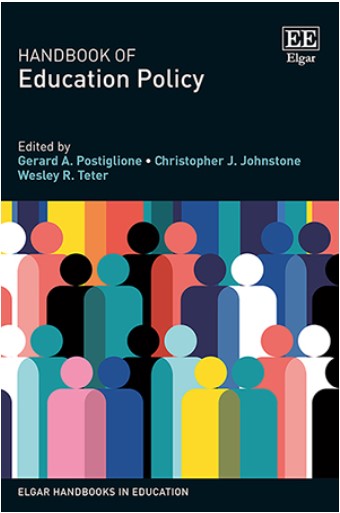
Edited by Gerard A. Postiglione (Professor Emeritus, Honorary Professor, The University of Hong Kong), Christopher J. Johnstone (Associate Professor, University of Minnesota, US) and Wesley R. Teter (Research Fellow, Center for Advanced School Education and Evidence Based Research, University of Tokyo, Japan)
Publisher: Edward Elgar Publishing
‘The new Handbook of Education Policy edited by Postiglione, Johnstone and Teter is a welcome addition to the academic literature on the transformation of education policy in the aftermath of the COVID-19 pandemic. The 22 chapters of this well-researched book give a comprehensive analysis of how education policy must adapt to a radically changed world. Through a skilful combination of thematic pieces and case studies from a large range of countries, the chapter authors challenge us to embrace new education policy concepts, such as public value governance and knowledge democratization, that can foster innovation and accountability in times of uncertainty. Gerard Postiglione, Christopher Johnstone, and Wesley Teter should be congratulated for this excellent scholarly contribution that has the potential of influencing policy makers all over the world to design and implement more sustainable and innovative education policies.’
– Jamil Salmi, Diego Portales University, Chile
‘This Handbook combines an up-to-date overview with theoretically-informed analysis of global education policies. It is erudite, insightful and original. It will be a vital resource for education policy researchers and an excellent starting point for students, in any location.’
– Stephen Ball, University College London, UK
This insightful Handbook is an essential guide to educational policy around the world. As shifting geopolitics, intensified climate change, and widening economic inequalities persist, the need for informed educational policy is critical.
Bringing together a unique collection of international case studies by scholars and practitioners from over twenty countries, the Handbook highlights how the contextual nature of educational policy and its implementation acknowledges both global trends and local nuance. Chapters explore key contemporary topics including the effects of the COVID-19 pandemic on international educational policy; opportunities for academic modernization in Ukrainian society; gender equality in Korean and Japanese universities; and inclusive education policies throughout the developing world, including India, South Africa, and Uruguay. It further discusses the ways in which governmental, non-governmental, and global education specialists are shaping new agendas focused on equity and responding to global crises.
Offering new perspectives on educational policy in a post-pandemic world, this comprehensive Handbook will be crucial reading for students and scholars of education policy, politics and public policy, sociology, and university management. It will also be beneficial for educational research associations and international development agencies, including UNESCO, the Asian Development Bank, and the World Bank.
Click here to access further details about the book.
Book review: Below is the book review for the “Handbook of Education Policy.” You can click on the image to view the full book review or simply click here to explore the book review in more detail.
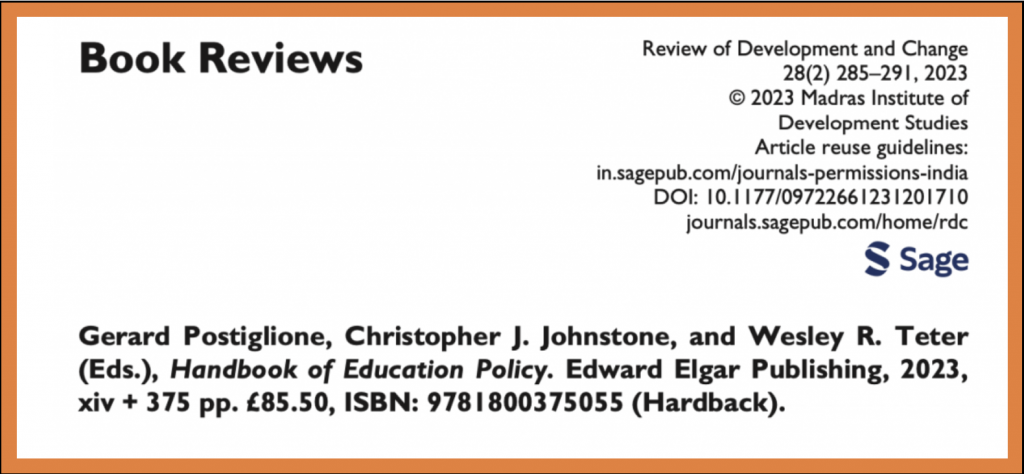
Tilak, J. B. (2023). Book review: Gerard Postiglione, Christopher J. Johnstone, and Wesley R. Teter (Eds.), Handbook of Education Policy