
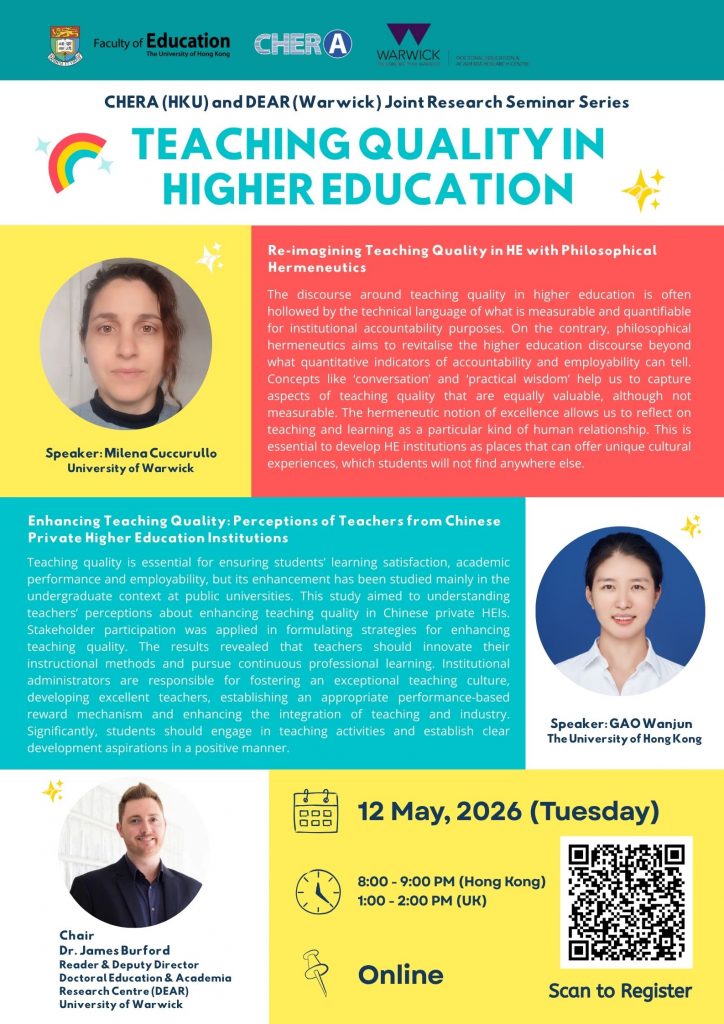
CHERA Seminar: Teaching Quality in Higher Education
Date: 12 May, 2026 (Tue)
Time: 08:00 PM – 09:00 PM HK, 1:00 PM – 2:00 PM UK
Venue: Online
Registration: Scan the QR code or use the link
Speakers
Milena Cuccurullo, University of Warwick
GAO Wanjun, The University of Hong Kong
Chair
Dr. James Burford, Reader & Deputy Director of Doctoral Education & Academia Research Centre (DEAR), University of Warwick
Abstract:
Re-imagining Teaching Quality in HE with Philosophical Hermeneutics
The discourse around teaching quality in higher education is often hollowed by the technical language of what is measurable and quantifiable for institutional accountability purposes. On the contrary, philosophical hermeneutics aims to revitalise the higher education discourse beyond what quantitative indicators of accountability and employability can tell. Concepts like ‘conversation’ and ‘practical wisdom’ help us to capture aspects of teaching quality that are equally valuable, although not measurable. The hermeneutic notion of excellence allows us to reflect on teaching and learning as a particular kind of human relationship. This is essential to develop HE institutions as places that can offer unique cultural experiences, which students will not find anywhere else.
Enhancing Teaching Quality: Perceptions of Teachers from Chinese Private Higher Education Institutions
Teaching quality is essential for ensuring students’ learning satisfaction, academic performance and employability, but its enhancement has been studied mainly in the undergraduate context at public universities. This study aimed to understanding teachers’ perceptions about enhancing teaching quality in Chinese private HEIs. Stakeholder participation was applied in formulating strategies for enhancing teaching quality. The results revealed that teachers should innovate their instructional methods and pursue continuous professional learning. Institutional administrators are responsible for fostering an exceptional teaching culture, developing excellent teachers, establishing an appropriate performance-based reward mechanism and enhancing the integration of teaching and industry. Significantly, students should engage in teaching activities and establish clear development aspirations in a positive manner.